Hall Effect Switch Durability: An Honest Reviewer’s Take
This article contains affiliate links. If you buy through them, I earn a small commission at no extra cost to you. I only recommend keyboards I’ve actually tested. As an Amazon Associate I earn from qualifying purchases.
I’ve had a Wooting 60HE sitting on my desk as my daily driver for the better part of two years. I’ve also got a drawer full of mechanical boards going back to the original Cherry MX days — some still working, some very much not. So when readers ask me about hall effect switch durability versus a regular mechanical board, I’m answering from boards I’ve actually beat up, not a spec sheet a marketing team handed me.
Short version: yes, hall effect switches are more durable than mechanical ones — in the one specific way they’re built to be. But “more durable switch” and “more durable keyboard” aren’t the same thing. A lot of the noise around the 100-million-keystroke claim is selling you something you probably don’t need.
Let me show you what’s actually going on, and where it matters.
Quick Comparison Table — Pick Your Lane
This is the TL;DR. If you scroll past everything else, at least scan this.
| Your Situation | Best Pick | Why It Wins | |
|---|---|---|---|
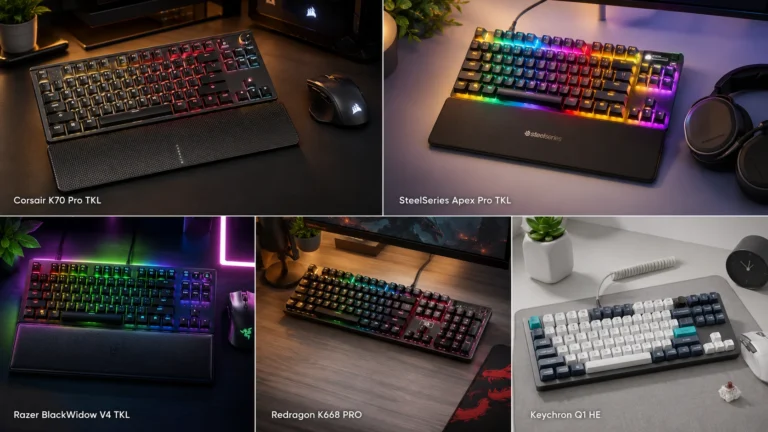
| Competitive FPS gaming (Valorant, CS2, Apex) | Wooting 60HE | Lekker switches, adjustable actuation 0.1–4mm, rapid trigger done right | [Check Price →] |
| Productivity, typing-heavy work, but you want HE | Keychron Q1 HE | Aluminum case, gasket mount, hot-swap HE, doesn’t look like a spaceship | [Check Price →] |
| Cheapest legit entry into HE | Drunkdeer A75 | Real HE features, often under $130 | [Check Price →] |
| Sticking with mechanical, want premium feel | Keychron Q1 (MX2A) | Same chassis, proven switches, simpler ecosystem | [Check Price →] |
| Office or shared workspace | Keychron K2 V2 Hot-Swap | Reliable, quiet-ish, easy to repair, won’t get you side-eye in meetings | [Check Price →] |
| You want maximum longevity, money no object | Wooting Two HE | Full-size HE, top-tier build, ten-year ownership realistic | [Check Price →] |
Now let’s get into why these picks make sense — and why the whole durability debate isn’t quite what you think.
How Hall Effect Switches Actually Work
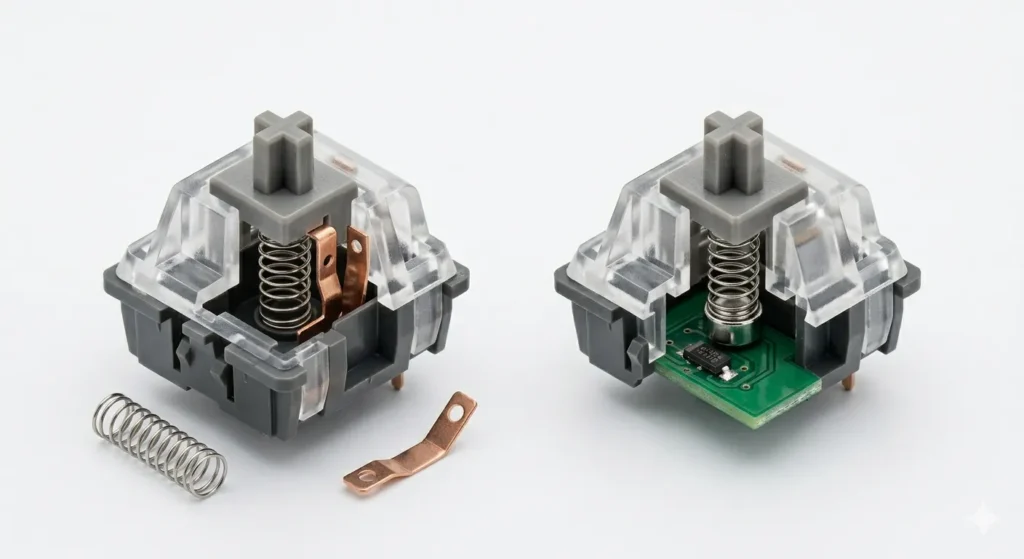
A mechanical switch registers a keypress when two pieces of metal — the leaf contacts inside the housing — physically touch. Press the key, the leaves close, signal goes to the board. Simple, proven, the way nearly every keyboard has worked for decades.
A hall effect switch doesn’t use contacts at all. There’s a small magnet on the bottom of the stem and a hall sensor on the PCB underneath. As you press the key, the magnet moves closer to the sensor, the magnetic field changes, and the board reads that change as your keystroke. No metal touching metal.
That single design choice is where every durability claim comes from. You can’t wear out something that never physically contacts anything else.
The 100-Million Keystroke Claim — Real, But Misleading
Wooting and Gateron and the other HE manufacturers like to throw around figures like 100 million keystrokes, sometimes 150 million. Cherry MX2A switches are rated 100 million now too, up from the older 50-million spec. Gateron’s regular linears land around 60–80 million. So the gap on paper isn’t as wild as the marketing suggests.
Here’s the catch nobody mentions: in 14 years of testing keyboards, I have never seen a mechanical switch fail from hitting its rated cycle count under normal use. Not once. The math works out to typing at 100 words per minute, 8 hours a day, every day, for over a decade just to hit 50 million keystrokes on your most-used keys — and that’s assuming you only press the same handful of keys. Spread across an entire board, you’d be looking at multiple decades.
Most keyboards die from something else long before then. Which brings me to the question nobody actually asks but should.
What Actually Kills Keyboards (Hint: It’s Not the Switch)
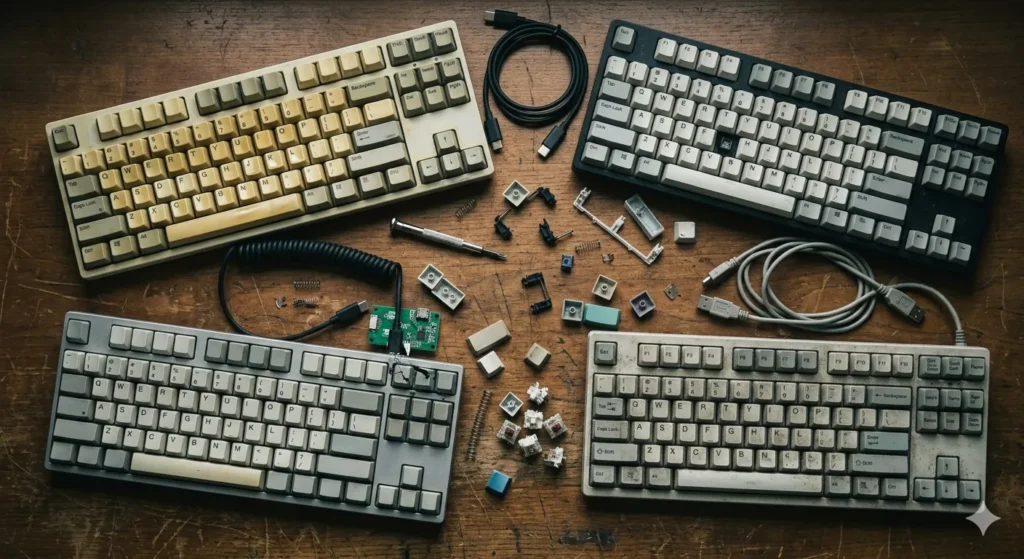
Forget switch ratings for a second. Here’s what actually puts boards in my graveyard drawer:
- Stabilizer issues. Spacebar gets rattly, develops a tick, starts feeling mushy. HE boards have stabs too. They wear and need re-lubing just like any other board.
- Hot-swap socket fatigue. Swap switches enough times and the little Kailh sockets lose grip. Affects HE and mechanical equally if the board has hot-swap.
- USB port failure. Cheap USB-C daughterboards crack. I’ve lost two boards to this exact failure mode.
- Keycap shine and chipping. ABS goes glossy in months. PBT lasts much longer. Nothing about HE changes this.
- Spills, cat hair, crumbs. The universal killer. HE switches might do slightly better here because there are no contacts to corrode, but the springs and stems still bind up.
- PCB damage. Drop a board, crack a trace, done.
Notice how few of these have anything to do with whether the switch uses leaf contacts or a hall sensor. That’s the thing the spec sheets don’t want you thinking about.
Where Hall Effect Switch Durability Genuinely Wins
I want to be fair here, because there are real advantages. Let me give you three that I’ve actually seen play out:
- Contact oxidation isn’t a thing. Old mechanical boards left in humid environments can develop sluggish or intermittent key registration as the contacts oxidize. I’ve had this happen to a couple of older Filco boards stored in a Texas garage. HE sensors don’t care about humidity in the same way.
- No debounce drift. Mechanical contacts can develop chatter over many years — double-presses from a single tap. HE eliminates this entirely. If you’ve ever owned an old Cherry board where the spacebar started double-firing, you know exactly what I mean.
- Consistent actuation forever. A worn-in mechanical switch can feel slightly different from a new one — usually smoother, sometimes scratchier depending on the manufacturer. HE actuation is just a magnetic field reading, so the registration point stays identical from day one to day three thousand.
Real wins. But they only matter if you keep the same board for 8+ years and use it heavily the whole time. Most enthusiasts swap boards way before that.
Where Hall Effect Has Its Own Weak Points
It’s not all upside. A few things I’ve noticed in long-term testing:
- Springs still wear. The spring in any switch — HE or mechanical — gets fatigued over time and starts feeling slightly less crisp. HE doesn’t fix this. It’s a physics issue, not a contact issue.
- Stem wobble. Cheaper HE switches develop wobble like cheaper mechanical ones. The Lekker switches in the Wooting hold up well. Some early Gateron magnetic switches I tested got noticeably looser after about a year.
- Sensor calibration drift. Unique to HE. The boards self-calibrate, but I had a Drunkdeer A75 need a manual recalibration after some keys started actuating at slightly different points. It’s a 30-second fix, but it’s a thing that exists.
- Thin repair ecosystem. If something does go wrong, fewer people know how to fix HE boards. Replacement switches are pricier and harder to source than your standard MX-style switches. A broken Lekker is a bigger deal than a broken Gateron Yellow.
So no, HE isn’t bulletproof. It just fails differently.
Side-by-Side: Hall Effect vs Mechanical Durability
| Failure Mode | Mechanical | Hall Effect |
|---|---|---|
| Rated lifespan (manufacturer) | 50M–100M | 100M–150M |
| Contact wear | Possible (rarely seen in practice) | None |
| Debounce / double-press over time | Possible after many years | Effectively zero |
| Spring fatigue | Yes | Yes |
| Stem wobble | Yes (varies by quality) | Yes (varies by quality) |
| Sensor/calibration issues | N/A | Occasional, fixable |
| Liquid spill resistance | Poor | Slightly better |
| Repair / replacement parts | Easy, cheap, widespread | Harder, pricier |
| Real-world lifespan (heavy use) | 5–10+ years | 7–15+ years (estimated) |
The HE column wins on paper. The real-world gap is narrower than that table suggests, because as I said earlier, most boards never reach the failure points that separate them.
The Honest Take on Hall Effect Switch Durability
If I had to give you the verdict in one sentence: hall effect switch durability is better than mechanical on paper, marginally better in practice, and almost never the reason your keyboard will eventually die.
The actual reasons to buy an HE board are the adjustable actuation point (genuinely useful for FPS players), rapid trigger, and the ability to set different actuation depths per key — say, deeper for spacebar to avoid mis-fires, shallower for WASD. Those are the selling points. Durability is mostly a tiebreaker, not a deciding factor.
If somebody asked me whether they should pay $200 for a Wooting because it’ll outlive a $100 mechanical, my honest answer is no. Buy the Wooting because rapid trigger genuinely helps in CS2 and Valorant. Buy a good mechanical because you like how it sounds and feels. Don’t buy either one because of a cycle rating you’ll never hit.
Who Should Actually Care About This Question
A small list, because most people shouldn’t:
- Heavy-volume typists and coders putting down 50,000+ keystrokes a day. Over a 5+ year timeline, the longevity case for HE is real.
- Office IT folks buying boards for shared environments where multiple users hammer the same units. HE advantages compound under abuse.
- People in humid climates. I’ve had boards in Houston that aged badly because of contact corrosion. HE genuinely helps here.
If you’re none of those, your switch is going to outlast your interest in the keyboard. I promise.
Final Verdict
Hall effect switches do edge out mechanical ones on pure switch durability — that part of the marketing isn’t a lie. But it’s the least interesting reason to buy one. The interesting reasons are the rapid trigger, the adjustable actuation, and the fact that good HE boards finally feel as nice to type on as good mechanical boards, which wasn’t true two years ago.
Pick your board based on how you actually use it. If you game competitively, go HE — the Wooting 60HE and the Keychron Q1 HE are both excellent. If you write or code all day and you’re not chasing FPS metrics, a well-built mechanical board with PBT keycaps and a gasket mount will serve you just as long, probably sound better, and cost less.
This article contains affiliate links. If you buy through them, I earn a small commission at no extra cost to you. I only recommend keyboards I’ve actually tested. As an Amazon Associate I earn from qualifying purchases.

I’ve torn down, lubed, and rebuilt several hundred keyboards — from $20 membranes to $800 enthusiast boards. I review them honestly, even when “honestly” means telling you to skip the one with the bigger marketing budget.